Code Generator - Engineering Productivity for Business Development
In ProgressTools & Efficiency
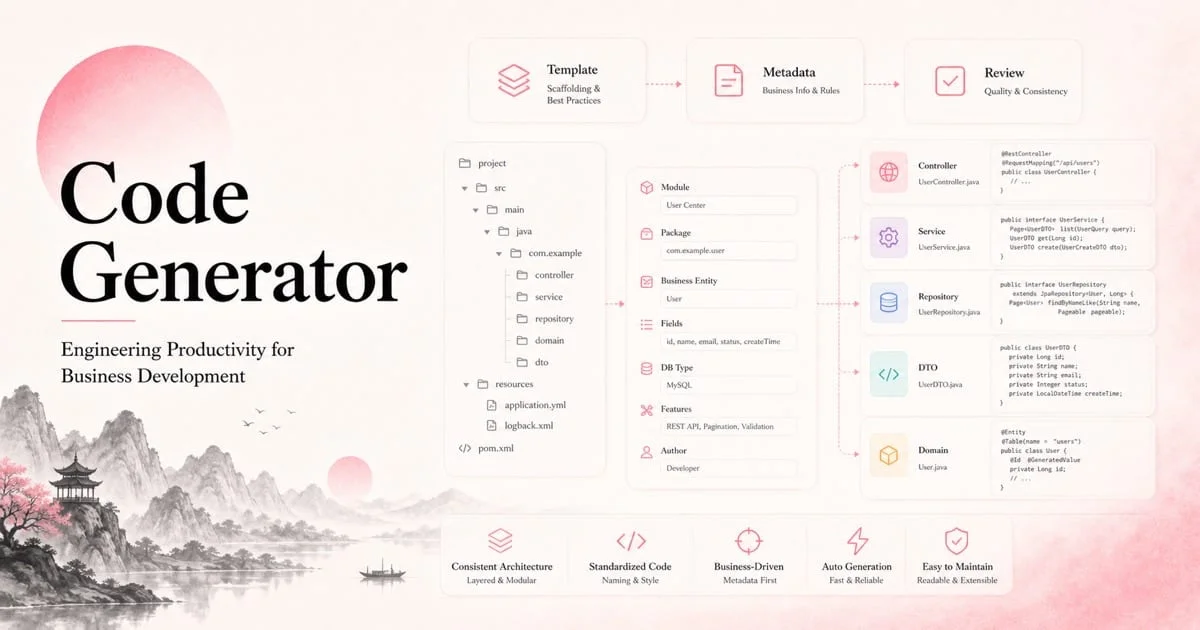
A code generator practice project for business development workflows, exploring how templates, metadata configuration, and AI assistance can generate common business code with less repetition and more consistency.
Project Profile
- Phase
- Internal Practice
- Visibility
- No Internal Links
- Next Step
- Improve template governance, API-field extraction, generated-code checks, and human review flow.
- Project Relation
- An engineering-productivity project that turns repetitive business development into templated and AI-assisted workflows.
- Boundary
- Kept as internal practice. Internal repositories, schemas, endpoints, and production details are not public.
- Tech Stack
- Python
- Flask
- Java
- Template
- MySQL
- AI API
One-Line Positioning
The code generator is an engineering productivity tool for business development. It explores how repetitive CRUD structures, API skeletons, template code, and convention checks can become configurable and reviewable generation workflows.
It is not a generic low-code platform and it does not replace engineering judgment. It is closer to a practical “repetition compressor” for real business development.
Why It Exists
Business systems contain many code structures that are similar but not identical: entities, DTOs, mappers, services, controllers, form configuration, field validation, API documentation, permission points, and initialization scripts.
Writing all of this manually is slow and error-prone. A generator can preserve consistency by turning repeated structure into templates and exposing the variable parts as configuration.
Core Approach
- Select databases and tables from a web page, read field metadata, and generate code skeletons.
- Use metadata to describe business objects, fields, validation, permissions, and generation scope.
- Generate common Java backend code such as DTO / Model / VO / Service / DAO / Controller files and supporting configuration from templates.
- Use AI APIs to extract parameters from API documents or requirements, assist naming, descriptions, comments, and boundary checks, without skipping human review.
- Keep generated output readable, editable, and reversible instead of hiding it behind a black box.
Current State
The project is still an internal practice and refinement effort. It is used to validate engineering productivity ideas and does not expose internal business models, real table structures, endpoint addresses, or customer information.
Relationship with Other Projects
The code generator belongs to the engineering-productivity layer. Unlike AscendLab public tools, it is closer to internal practice for business development workflows. The public page records the idea and boundaries, not internal links.
Boundaries
- Internal templates, business fields, and production configuration are not public.
- AI-generated code is not treated as trusted output without review and tests.
- The goal is to reduce repetitive work, not to replace architecture design or business understanding.
Project Asset
Asset Connections
How this project connects to topics, reading paths, series, and future writing.Reading Paths
- Backend Engineering TopicInput, processing, output, review, and risk boundary
- Indie Building TopicHow productivity practice becomes a method
Related Series
- Java Backend & MicroservicesBusiness backend and template-code source context
Related Entries
- Spring Cloud Gateway Rate LimitingTypical target for engineering templates
Project Timeline
- Internal PracticeSupports repetitive business development and template generation
- Review StageEmphasizes human review and safety boundaries
Next Content Plan
- Keep explaining input, processing, output, review, and risk boundaries.
- Keep it marked as internal practice with no internal repos, schemas, endpoints, or production details exposed.
Project FAQ
- Will the code generator expose internal implementation?
- No. The public page only explains method and boundary, without internal repositories, APIs, schemas, or production config.